Court order suspended NNR decision making

After Minister Mantashe suspended the civil society representative on the Board of the National Nuclear Regulator (NNR), an urgent court date was set to challenge the legality of this suspension. This appeared to be an open and shut case, and so the Minister through the State Attorney, and the NNR through the firm MacRobert Attorneys, reached out to make a settlement.

As part of the settlement, the Minister agreed to make a decision on whether or not to discharge the community representative, Peter Becker, by 15 February 2022. In the same settlement, the NNR agreed to suspend all decision making and meetings of the Board and subcommittees while the illegal suspension was in effect. This settlement agreement was made an order of the High Court. As it turned out, the Minister did not meet the deadline, and it is not know whether or not the NNR complied with the order.

Continue reading →

Suspension of NNR Board member challenge: settlement reached

Issued by Rodney Anderson, of Save Bantamsklip

Save Bantamsklip | Xplorio Gansbaai

Six months after appointing a Board member to the Board of National Nuclear Regulator (NNR) in order to represent affected communities, Minister Mantashe unlawfully suspended Peter Becker on 18 January 2022. He has been a vocal campaigner against nuclear power in South Africa for about 12 years, and when Mantashe appointed him in June 2021 it was widely welcomed as an enlightened step. According to the NNR Act of 1999, the NNR Board also includes a member from the Department of Mineral Resources and Energy (DMRE), well known for a very pro-nuclear stance.

Continue reading →

Modelling report: Koeberg life extension costs the country

It is generally agreed that nuclear power comes with an inherent risk. What is hotly debated is whether or not there are benefits which outweigh that risk. When it comes to the Koeberg Nuclear Power Plant, Eskom have had the approach that since Koeberg produces electricity at a cost of around R0.45 per kWh, it is a ‘no-brainer’ to spend whatever is needed on a refurbishment to extend the life of the plant beyond the end of its design life in 2024.

A recently released modelling report estimates that doing that refurbishment would result in additional costs of R50bn “from a combination of the actual costs of life extension, additional open cycle gas turbine (OCGT) usage, large key-customer curtailment requests/instructions, and scheduled load-shedding.” It will also increase carbon emissions due to the additional use of OCGTs.

Continue reading →

Mantashe ignores demand to lift suspension of Board member

Previous posts have described how the NNR Board member Peter Becker, who was appointed to the NNR Board to represent communities was first excluded from Board processes in early January 2022, then formally suspended by Minister Mantashe on 18 January, as well as the response to the suspension letter. The Minister was subsequently sent the letter below, which demanded that he lift the suspension due to the fact that while he has the power to discharge a Board member, he has no power to suspend.

Continue reading →

Civil society representative excluded from NNR board

The National Nuclear Regulator (NNR) is tasked with protecting the public and the environment from radiation. The NNR Act of 1999 requires that the Board of the NNR includes a person representing civil society. Despite that, in 2020 civil society became progressively unhappy that there seemed to be no such representative.

After being nominated by several organisations in late 2020, in June 2021, Peter Becker of the Koeberg Alert Alliance was appointed to the Board to fulfil this role.

Currently, there is a lot of attention on the work being done at Koeberg which requires prior approval from the NNR. There are meetings of the Board this week where technical aspects of these matters will be discussed and decided on.

On Monday 17 January Becker was refused access to the agenda and document packs for these meetings by the Board secretary, and his access to the online document portal has been revoked. He wrote to the Board chair asking for a reason, but to date no response has been received. He also was not invited to the online meetings.

Continue reading →

Eskom statement re Koeberg outage confusing and disingenuous

On 15 January Eskom released a statement saying that Koeberg unit 2 “will on Monday 17 January 2022 be taken offline for a regular refuelling and maintenance outage that is scheduled for five months.”

Setting the disingenuous tone
Firstly it is disingenuous to call this a “regular refuelling” outage. It is about as accurate as saying your car is going to the mechanic for refuelling, and by the way while busy filling the tank they will also replace the gearbox. The vast majority of the cost and the duration of the outage will be to do the refurbishment, so it is more accurate to call this a refurbishment outage.

Continue reading →

Anti-nuclear protest highlights safety concerns at Koeberg

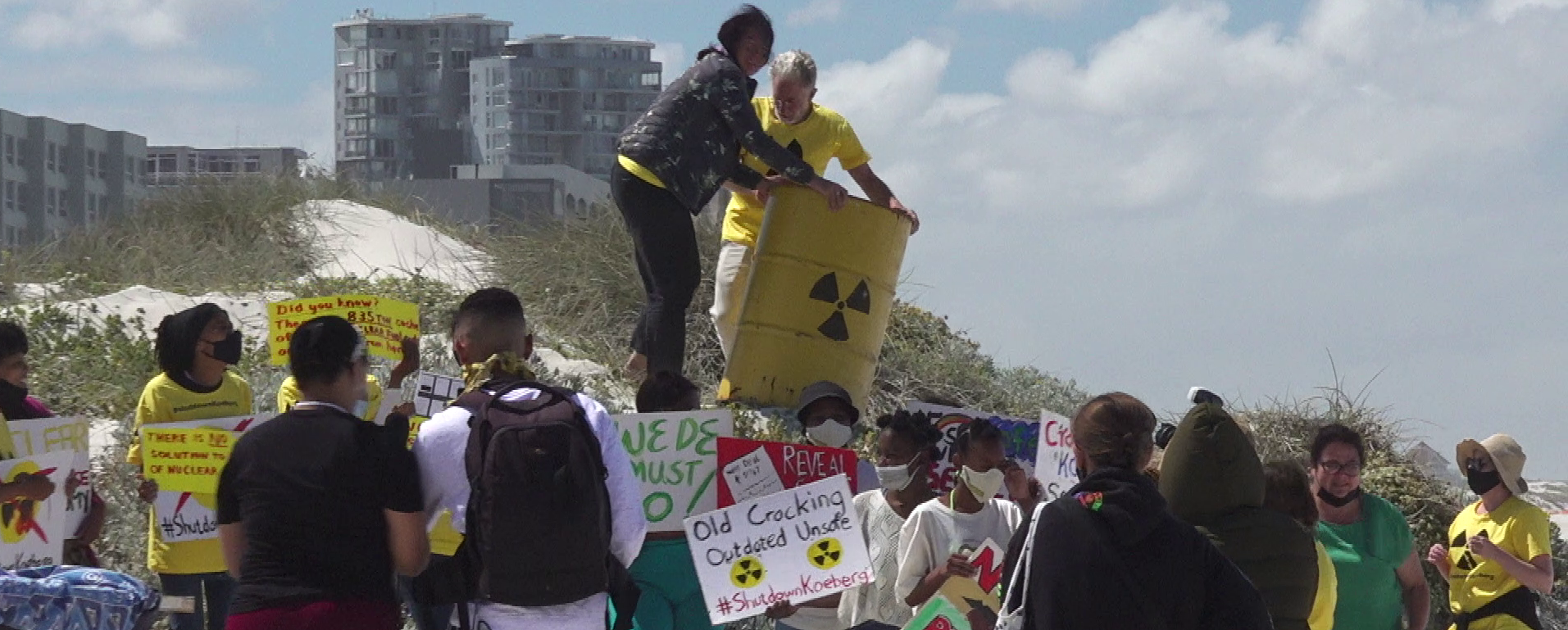
An anti-nuclear demonstration held on Bloubergstrand Beach on 16 December highlighted concerns of Capetonians about the implications of Eskom extending Koeberg’s lifespan next year. The nuclear plant reaches the end of its 40-year lifespan in 2024 but Eskom is trying to extend its operating life by another 20 years before any public consultation.

Demonstrators on beach holding posters
Continue reading →

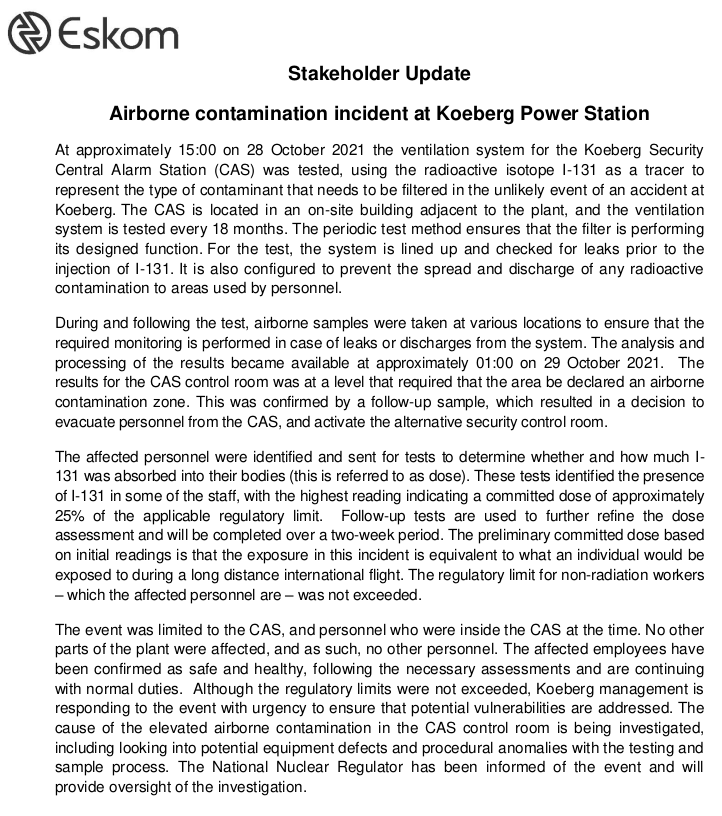
Koeberg airborne contamination incident

Shortly after midnight on 28 October 2021 some test results became available which found excessive levels of Iodine-131 in the ventilation system at the Koeberg nuclear power station. This was likely a result of a test which had been done in the afternoon, combined with faulty filtration systems that meant the Koeberg Security Central Alarm Station (CAS) had to be evacuated.

While it is reassuring that Eskom were testing this safety system, no standard test procedure includes evacuating all staff from the security nerve centre of a nuclear plant. Clearly there was something significantly wrong.

While Eskom has not released much by way of detail, it is likely to be a result of a combination of three factors.

Continue reading →

Is Koeberg really run under a permit from the IAEA?

On the Cape Talk show ‘Breakfast with Refilwe Moloto’ on 29 October 2021 the issue of the safety of the Koeberg Nuclear Power plant was discussed with guest Mike Rossouw. Rossouw mentioned the International Atomic Energy Agency, and made some statements which are in need of correction. (Cape Talk has subsequently done a follow up which can be heard here.)

On the show Rossouw said that “Eskom is regulated by an International Nuclear Agency”, which is incorrect. The IAEA can only make recommendations to a member country, and member countries are free to implement, or ignore, those recommendations. For example, in 2013 the IAEA made several recommendations concerning South Africa, and while some of these have been implemented, others have simply been ignored for the past eight years.

Consequently, Eskom does not require a ‘permit’ from the IAEA to operate Koeberg, as Rossouw stated on the show. He said “the real risk is that the Agency will recall their permit, in which case they will have to shutdown”.

Continue reading →

NERSA conditional nuclear concurrence distracts from Koeberg problems

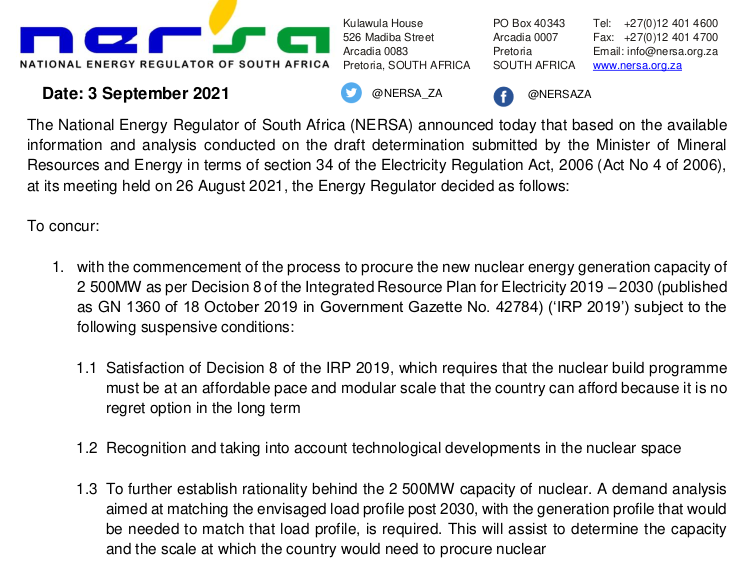
NERSA conditional concurrence with new nuclear

The National Energy Regulator of South Africa (NERSA) has given a conditional concurrence with the section 34 ministerial determination to proceed with procuring a new nuclear plant. This concurrence has some crucial suspensive conditions, in particular 1.3. This makes it clear that given the information put before NERSA, the decision to go ahead with a nuclear build cannot be considered rational.

Continue reading →