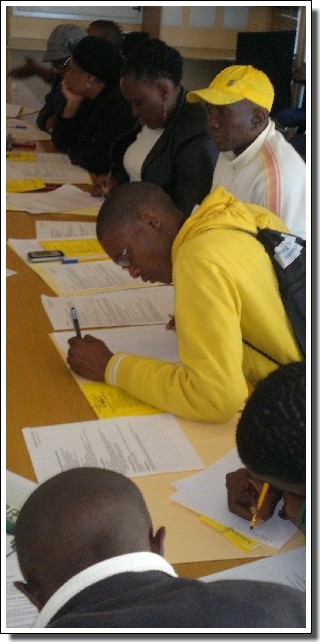
 In June representatives of Eartlife Africa Jhb and Greenpeace visited Cape Town and the Hermanus area. Several meetings with other organisations were arranged, including one in Woodstock with Right To Know activists. Plans for a national ‘nuclear school’ where discussed, but funding would be required. This would be unlikely to happen before October and since the next draft of the Nuclear-1 Environmental Impact Report was due to be released around October, it was agreed that workshops should be arranged before that if possible. To maximise impact, the workshops would be in ‘train the trainers’ format, to capacitate activist leaders to speak authoritatively on the nuclear issue. Continue reading
Category Archives: Government
Official report on Fukushima – what can South Africa learn?
 An independent in depth report on the Fukushima nuclear disaster commissioned by the Japanese parliament was released in July 2012, and it comes to some very important conclusions. As Eskom attempts to get approval to build three more nuclear plants along the southern coast, South Africa should be looking very closely at this report to see if there are lessons we should learn from it.
The earthquake or the tsunami?

The tsunami swamping the sea barrier at Fukushima
The nuclear industry has repeatedly made the claim Continue reading
‘Secret’ REBID documents revealed
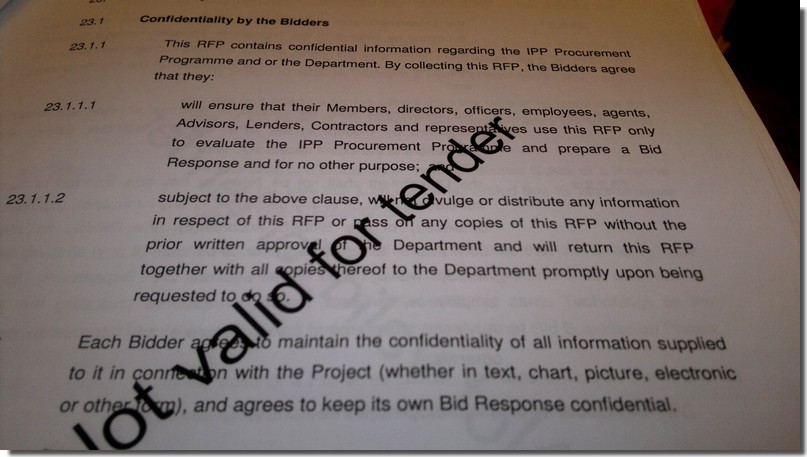
When the Department of Energy called for bids to supply renewable energy to the South African grid, they produced a bid document which described the conditions and information required from bidders. This was only available to prospective bidders who paid a fee of R15 000, and signed a confidentiality agreement which included the stipulation to “not divulge or distribute any information in respect of this RFP or pass on any copies of this RFP”.
Nuclear ‘renaissance’ stillborn
First published in Business Day, 23 July 2012
The nuclear power industry is deeply troubled, with little cause for optimism. There is growing worldwide public resistance to nuclear power stations, President Obama has terminated government subsidies in the USA for nuclear power, and Germany and Switzerland have committed to shutting down all their reactors. While the renewable energy industry has seen dramatic growth and constantly falling costs, the nuclear industry grapples with spiralling costs, the seemingly intractable waste disposal issue, and the ongoing huge economic and human costs of the Fukushima nuclear disaster.
A renaissance?
Why Eskom’s electricity demand forecasts are wrong – again
Eskom gave input into the Departments of Energy IRP2010 (Integrated Resource Plan) – some would say they wrote it on behalf of the Department. One of the key factors in planning electricity generation capacity is knowing what the demand will be. Currently, the electricity demand peaks at just under 40 000MW. Eskom projected than by 2030, the demand would be about 85 000MW, or about 4% compounded demand growth, every year. Continue reading
Evacuations and after effects of the Fukushima nuclear disaster
It is not unusual for those who favour nuclear power to downplay the effects of nuclear disasters that have happened. In the article “Nuclear power is a key part of SA’s future”, attributed to the South African Minister of Energy Dipuo Peters, I came across this example: ‘The International Atomic Energy Agency (IAEA) mission to Fukushima at the end of May 2011 concluded that “to date no confirmed long-term health effects to any person have been reported as a result of radiation exposure from the nuclear accident”‘. Continue reading
Top COP or Flop COP?
And finally, its over. Negotiations carried on until 3.30am this morning, and ended with the ‘Durban Deal’. It has three main features.
The Three Part Deal – KP, GCF, and … something
Firstly, the Kyoto Protocol (KP) will be extended in its current form for five years. Civil society is divided on whether this is a flop or ‘top’. Continue reading
Final hours of COP17
The final hours of COP17 are drawing to a close. Everyone is tired after two weeks of this process, and many negotiators have already left. The optimistic feelings of yesterday seem to have evaporated. Continue reading
Zuma confronts faith groups on nuclear power
At COP17 in Durban, there has been strong input from civil society that nuclear power is not the answer for South Africa.
Faith groups have long held the view that nuclear power is ethically indefensible, Continue reading
COP17 Negotiations Update
Hanging around at COP17 is a place to meet many people, and hear many different versions of what is going on inside the negotiations. One version I have heard is that the world may well be on the brink of a new age of climate negotiations. Continue reading

