At COP17 in Durban, there has been strong input from civil society that nuclear power is not the answer for South Africa.
Faith groups have long held the view that nuclear power is ethically indefensible, Continue reading
At COP17 in Durban, there has been strong input from civil society that nuclear power is not the answer for South Africa.
Faith groups have long held the view that nuclear power is ethically indefensible, Continue reading
Hanging around at COP17 is a place to meet many people, and hear many different versions of what is going on inside the negotiations. One version I have heard is that the world may well be on the brink of a new age of climate negotiations. Continue reading
This evening SAFCEI (the Southern African Faith Communities’ Environment Institute) called for a candlelight vigil outside the main entrance to COP17 at 7pm.
It started with a group of five activists lighting candles just inside the exhibition centre in Durban. Continue reading
A story doing the rounds here is that COP17 is like a doughnut. The centre of it is just air. The sweet part is all around the edges. Continue reading
The Heinrich Boell Foundation arranged a set of presentations and panel discussion on the theme of ‘Beyond coal and nuclear’. The three highly distinguished presenters were Kimiko Hirata of the Japanese organisation Kiko network which has its goal the prevention of dangerous climate change; Arne Jungjohann of the Washington office of the Heinrich Boell Foundation (HBF); and Michaele Schreyer, member of the supervisory board of HBF. Continue reading
Anti-nuclear sentiments have run high at the COP17 demonstrations. Together with Occupy activists, Koeberg Alert Alliance volunteers created a banner which reads ‘Nuclear Power is Intergenerational Tyranny’. This highlights the injustice inherent in a technology which produces power for the current generation, and leaves the very difficult problem of the high level waste to future generations, for thousands of years to come.
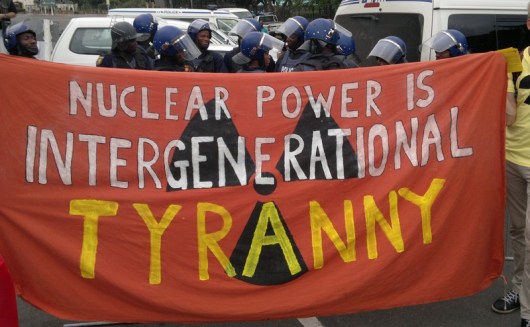
There was a lot of media attention Continue reading
In 2010 the Koeberg Alert Alliance (KAA) requested a copy of the Koeberg Emergency evacuation plan from Eskom, via the Promotion of Access to Information Act (PAIA). On the 2 June 2010 Eskom replied as below: Continue reading
As for any large project, the proposed building of a new nuclear power plant in South Africa required an Environmental Impact Assessment (EIA) process to be completed by independent experts. This results in an Environmental Impact Report (EIR) which must be presented to the public via a public participation process.
During some of these presentations, Peter Becker, of the Koeberg Alert Alliance videoed the proceedings. Continue reading
There has been a mounting concern that there are moves afoot to push through a decision on nuclear power over the next few months. The following was reported from a cabinet meeting on 9 November:
“2.9 Establishment of the National Nuclear Energy Executive Coordination Committee
Cabinet approved the establishment of the National Nuclear Energy Executive Coordination Committee (NNEECC) to implement a phased decision making approach to the nuclear programme. Cabinet further approved the establishment of the nuclear energy technical committee (NETC) to support the NNEECC.”
Of particular concern is the technical committee. Continue reading
Germany has been in the news recently for announcing that it has scrapped all plans for using nuclear power in the future. The magnitude of the nuclear disaster in Fukushima and the radioactive contamination there resulted in German voters making it very clear that any party supporting nuclear expansion would be in trouble in the polls. For the first time in history, the German Green Party won a regional election.
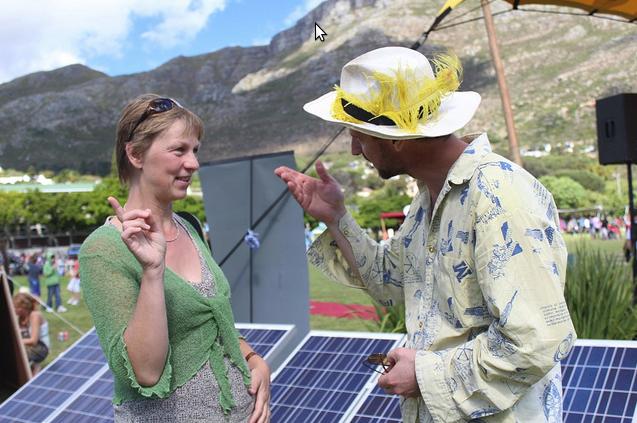
Goeddenhenrich and Becker discuss solar PV at the Hout Bay Green Faire
But what about the 26 new coal power stations that Germany is planning to build as a result of abandoning nuclear power? Continue reading
 KOEBERG ALERT ALLIANCE