Where did the R1bn compensation claim paid by Eskom go?

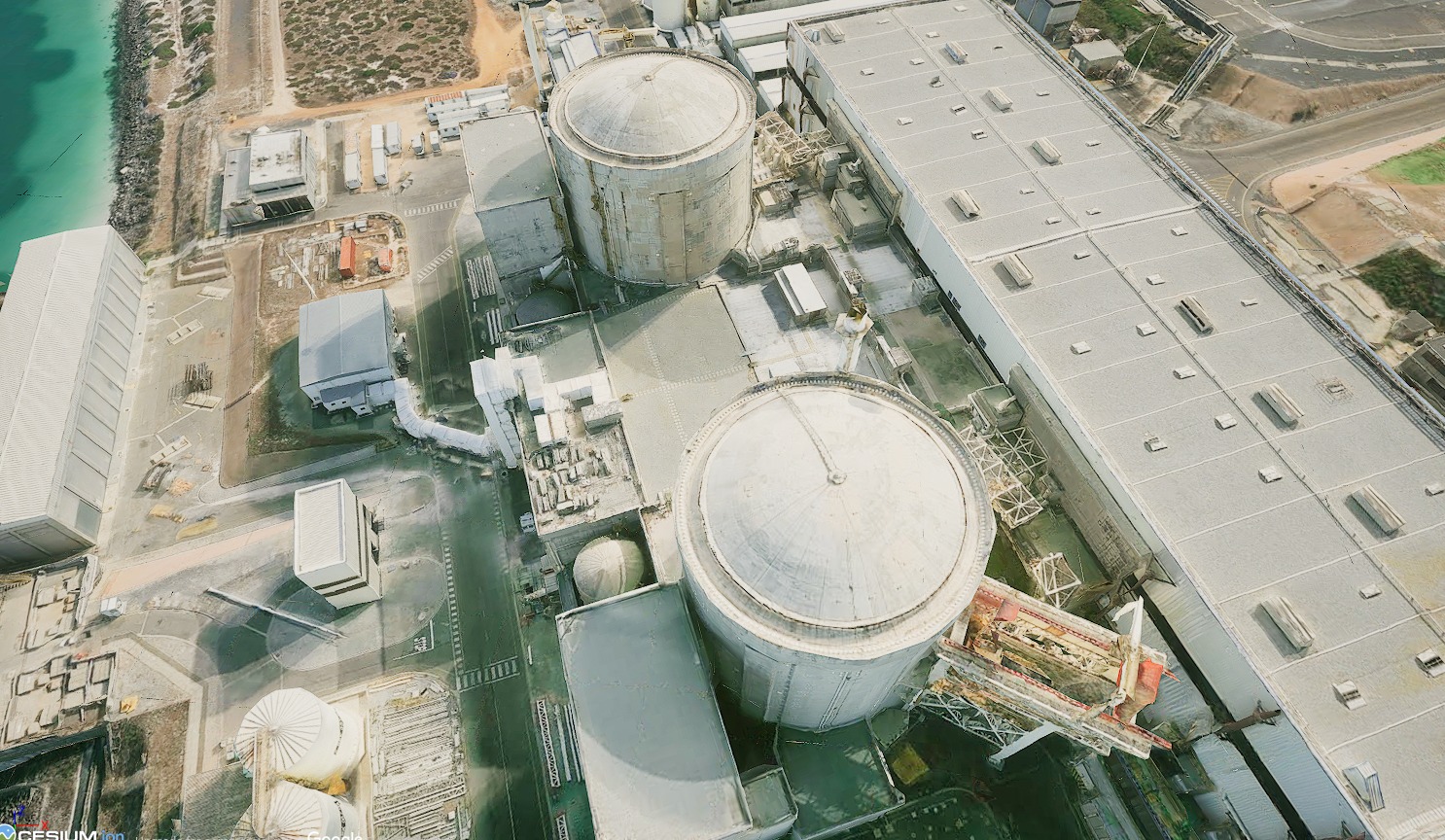
Eskom has been ordered by the Western Cape High Court to pay a R1 billion compensation claim to Framatome, the supplier for the Steam Generator Replacement (SGR) project at Koeberg Nuclear Power Station. This costly consequence stems from a January 2022 decision by the National Nuclear Regulator (NNR) to approve the SGR project, despite Eskom’s failure to complete a building for the safe storage of the old, highly radioactive steam generators. 

The R1 billion, if paid, could potentially be shared between Framatome, Lesedi (the local contractor) and various subcontractors such as multinational engineering firm, Asea Brown Boveri (ABB). 

Continue reading
Civil society responds to draft IRP: Nuclear push is costly, risky and unjust

The current image has no alternative text. The file name is: mallinson-2.jpg

Civil society organisations have joined growing criticism of the Department of Electricity and Energy’s proposed expansion of nuclear energy in the recently released draft Integrated Resource Plan (IRP), raising concerns about its financial viability and even its legality.

Summary of the draft IRP

Released in January 2025, the draft IRP’s purpose is to provide a roadmap for meeting South Africa’s forecasted electricity demand and was originally prepared under Minister Mantashe in the Department of Mineral Resources and Energy but the responsibility has since been handed over to the new Minister of Electricity and Energy, Dr. Kgosientsho Ramokgopa.

Continue reading

Koeberg: Intermittent and unpredictable

Koeberg nuclear power station was recently unexpectedly offline for over a week owing to multiple trips at the facility which eventually, combined with a high level of unplanned outages at other plants and finally issues at Kusile, resulted in stage 3 load shedding. Koeberg has come under renewed scrutiny for its inconsistent power generation.

Eskom’s media statement released on Monday, 10 March 2025, was titled: “Koeberg Unit 2 successfully restored to service following unplanned outage, delivering 930MW of reliable baseload power to South Africa” but energy experts and civil society organisations refute the “reliable baseload” statement.

Continue reading

Civil society pushes for community inclusion in nuclear governance

Civil society organisations working in the areas of energy, climate, and sustainable development have called on the Minister of Electricity and Energy, Kgosientsho Ramokgopa, to initiate an open call for nominations to appoint a much-needed community representative to the National Nuclear Regulator (NNR) board.

“The position has been vacant for over three years,” says youth activist Gabriel Klaasen. “In that time, critical decisions about Koeberg and new nuclear generation have been made without any representation from affected communities on the NNR board. This contradicts the Minister’s stated commitment to meaningful and fully informed public participation in the energy sector.”

Continue reading

Minister Ramokgopa’s withdraws nuclear determination

In 2020 Minister Mantashe submitted a determination under section 34 of the Electricity Regulation Act to the National Energy Regulator of South Africa (NERSA) calling for the procurement of 2500MW of new nuclear generation capacity. After a public consultation process, NERSA issued a ‘conditional concurrence’, specifying three suspensive conditions. The main one of these was that the Minister had yet to demonstrate that such a procurement would be ‘rational’. The Department of Mineral Resources and Energy (DMRE) then submitted a response to these conditions to NERSA in July 2023 but controversially did not release that response to the public. The DMRE then announced it had received full concurrence from NERSA and was proceeding with the procurement process.

Many civil society organisations and academic groups maintain that there is no rational basis for a nuclear procurement, which is a possible explanation for the attempt by the DMRE and Mantashe to proceed without public scrutiny. Two organisations, SAFCEI and Earthlife Africa launched a court challenge which demanded that the reasons for lifting the suspensive conditions should also be subject to public comment.

Continue reading

Koeberg refurbishment costs vastly underestimated

Issues are mounting at the Koeberg nuclear plant as the life extension project gets further and further behind schedule, the exodus of skilled staff continues, the number of disputes between Eskom and the various contractors continues to mount alarmingly and the expiry date of the operating licence draws closer. Against this backdrop, analysts and activists have questioned the R21bn Eskom has provided for the project and are concerned that massive unreported costs overruns pose a substantial financial risk to Eskom and the Treasury.

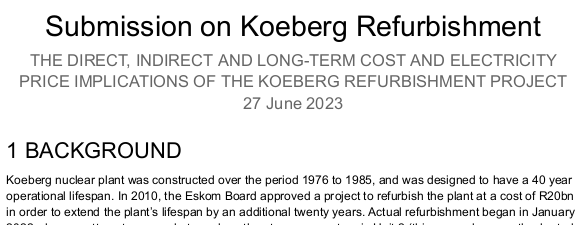
Title page of submission on costs of Koeberg life extension

A collaborative effort was made to compose a detailed report titled Submission on Koeberg Refurbishment which was sent to Treasury in early July 2023 by Lydia Petersen, a member of the Koeberg Alert Alliance and the Southern African Faith Communities’ Environment Institute (SAFCEI). To-date there has been no direct response or acknowledgment of receipt of the report from Treasury.

Continue reading

Koeberg costs South Africa

The Koeberg nuclear plant is the only nuclear power plant in Africa. Construction began in the 1970s and the plant came online in 1984. It operates under a licence from the National Nuclear Regulator (NNR) which expires in July 2024. In 2010 the Eskom Board approved spending R20bn on refurbishing Koeberg to extend its life by 20 years, provided that it received approval from the NNR. That approval has not as yet been given to Eskom by the NNR.

Currently Koeberg provides 3.5% of national nominal generating capacity, although over the past few years it has been plagued by problems. For most of 2022, unit 2 has been offline and the plant has run at half of its nominal capacity.

Continue reading

Modelling report: Koeberg life extension costs the country

It is generally agreed that nuclear power comes with an inherent risk. What is hotly debated is whether or not there are benefits which outweigh that risk. When it comes to the Koeberg Nuclear Power Plant, Eskom have had the approach that since Koeberg produces electricity at a cost of around R0.45 per kWh, it is a ‘no-brainer’ to spend whatever is needed on a refurbishment to extend the life of the plant beyond the end of its design life in 2024.

A recently released modelling report estimates that doing that refurbishment would result in additional costs of R50bn “from a combination of the actual costs of life extension, additional open cycle gas turbine (OCGT) usage, large key-customer curtailment requests/instructions, and scheduled load-shedding.” It will also increase carbon emissions due to the additional use of OCGTs.

Continue reading

Civil society representative excluded from NNR board

The National Nuclear Regulator (NNR) is tasked with protecting the public and the environment from radiation. The NNR Act of 1999 requires that the Board of the NNR includes a person representing civil society. Despite that, in 2020 civil society became progressively unhappy that there seemed to be no such representative.

After being nominated by several organisations in late 2020, in June 2021, Peter Becker of the Koeberg Alert Alliance was appointed to the Board to fulfil this role.

Currently, there is a lot of attention on the work being done at Koeberg which requires prior approval from the NNR. There are meetings of the Board this week where technical aspects of these matters will be discussed and decided on.

On Monday 17 January Becker was refused access to the agenda and document packs for these meetings by the Board secretary, and his access to the online document portal has been revoked. He wrote to the Board chair asking for a reason, but to date no response has been received. He also was not invited to the online meetings.

Continue reading

Eskom statement re Koeberg outage confusing and disingenuous

On 15 January Eskom released a statement saying that Koeberg unit 2 “will on Monday 17 January 2022 be taken offline for a regular refuelling and maintenance outage that is scheduled for five months.”

Setting the disingenuous tone
Firstly it is disingenuous to call this a “regular refuelling” outage. It is about as accurate as saying your car is going to the mechanic for refuelling, and by the way while busy filling the tank they will also replace the gearbox. The vast majority of the cost and the duration of the outage will be to do the refurbishment, so it is more accurate to call this a refurbishment outage.

Continue reading