Minister Ramokgopa’s withdraws nuclear determination

In 2020 Minister Mantashe submitted a determination under section 34 of the Electricity Regulation Act to the National Energy Regulator of South Africa (NERSA) calling for the procurement of 2500MW of new nuclear generation capacity. After a public consultation process, NERSA issued a ‘conditional concurrence’, specifying three suspensive conditions. The main one of these was that the Minister had yet to demonstrate that such a procurement would be ‘rational’. The Department of Mineral Resources and Energy (DMRE) then submitted a response to these conditions to NERSA in July 2023 but controversially did not release that response to the public. The DMRE then announced it had received full concurrence from NERSA and was proceeding with the procurement process.

Many civil society organisations and academic groups maintain that there is no rational basis for a nuclear procurement, which is a possible explanation for the attempt by the DMRE and Mantashe to proceed without public scrutiny. Two organisations, SAFCEI and Earthlife Africa launched a court challenge which demanded that the reasons for lifting the suspensive conditions should also be subject to public comment.

Continue reading
State of disaster regulations a nightmare

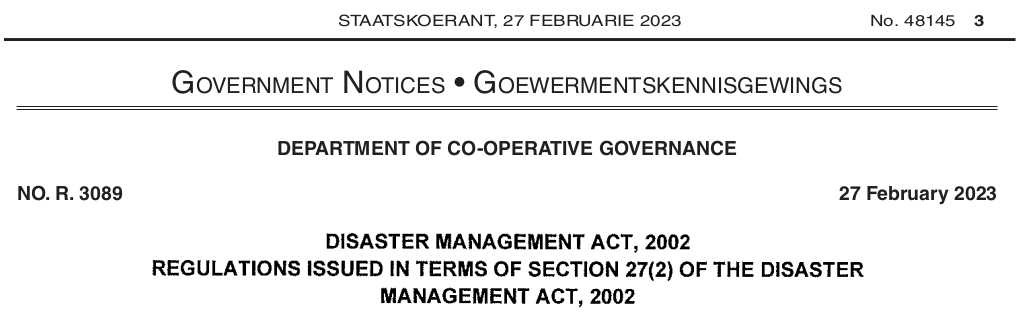
On 27 February 2023 the Department of Cooperative Governance and Traditional Affairs gazetted the national state of disaster regulations related to South Africa’s energy crisis.

When the government first announced that it intended to declare a state of disaster, many experts and organisations stated that it was not necessary and a relaxed legislative environment would erode democratic governance. Inaction by the Department of Mineral Resources and Energy (DMRE) caused the high levels of load shedding. Declaring a state of disaster was just an attempt to deflect blame.

This declaration of a state of disaster to “cut through the red tape” also allows the state to bypass important regulations and processes which is a major concern.

Continue reading

The Risks of an “Energy Emergency”

A declaration of an ‘energy emergency’ has been touted as a necessary step to “cut through the red tape” and address the electricity crisis. But what exactly does this mean? Which regulations or processes will be bypassed?

When it comes to the Koeberg nuclear plant, one upcoming regulatory requirement and a concern for those advocating for a life extension is getting approval from the National Nuclear Regulator (NNR). The current operating licence expires in July 2024, and without the NNR granting a life extension, this is when the plant will have to be permanently shut down.

Continue reading

NERSA conditional nuclear concurrence distracts from Koeberg problems

NERSA conditional concurrence with new nuclear

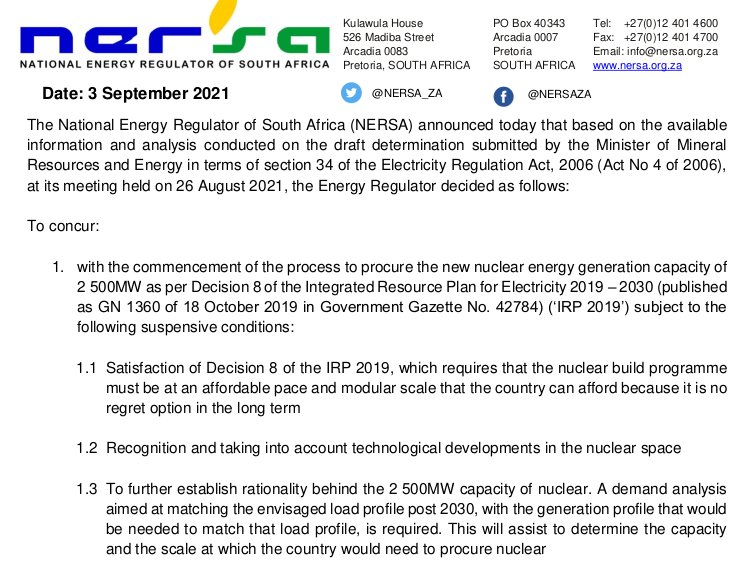
The National Energy Regulator of South Africa (NERSA) has given a conditional concurrence with the section 34 ministerial determination to proceed with procuring a new nuclear plant. This concurrence has some crucial suspensive conditions, in particular 1.3. This makes it clear that given the information put before NERSA, the decision to go ahead with a nuclear build cannot be considered rational.

Continue reading

Extension Granted for Appeal Against Nuclear-1 Authorisation

On 11 October 2017 the Department of Environmental Affairs (DEA) issued an authorisation to Eskom for a second nuclear power plant at Koeberg, 28km north of Cape Town City centre.  This was in response to a final Environmental Impact Report submitted to the Department by Gibb (Pty) Ltd on behalf of Eskom, the applicant.

Please sir, may we have some more time?
We wrote to the Department on 30 October, requesting an extension of the 30 day appeal period, which was set to expire on 1 December 2017. Continue reading

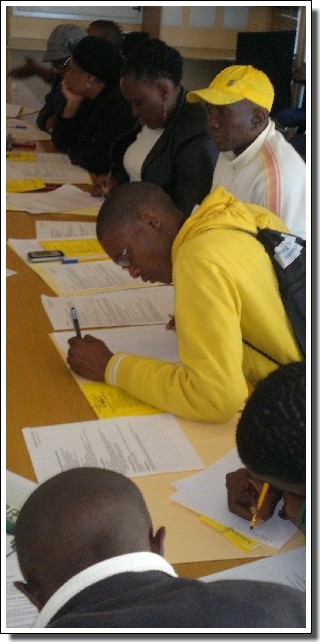
Electricity and nuclear costs workshop in Khayelitsha

In June representatives of Eartlife Africa Jhb and Greenpeace visited Cape Town and the Hermanus area.  Several meetings with other organisations were arranged, including one in Woodstock with Right To Know activists.  Plans for a national ‘nuclear school’ where discussed, but funding would be required. This would be unlikely to happen before October and  since the next draft of the Nuclear-1 Environmental Impact Report was due to be released around October, it was agreed that workshops should be arranged before that if possible.  To maximise impact, the workshops would be in ‘train the trainers’ format, to capacitate activist leaders to speak authoritatively on the nuclear issue. Continue reading