Minister suspends Civil Society representative to NNR

Further to our previous post re being excluded from Board meetings, Peter Becker, the representative of communities potentially affected by decisions of the National Nuclear Regulator, has been formally suspended with immediate effect.

Becker strenuously denies all the allegations of ‘misconduct’ and ‘conflict of interest’ which have been made against him and hopes to challenge this decision and have it reversed.

Meanwhile, the Regulator presses forward with deliberating on what approvals to grant the Koeberg Nuclear plant at a critical time when work is about to start to extend its lifetime by twenty years. This is precisely the time when it would be in the public interest to have someone with Becker’s expertise involved in oversight of NNR processes.

Continue reading
Civil society representative excluded from NNR board

The National Nuclear Regulator (NNR) is tasked with protecting the public and the environment from radiation. The NNR Act of 1999 requires that the Board of the NNR includes a person representing civil society. Despite that, in 2020 civil society became progressively unhappy that there seemed to be no such representative.

After being nominated by several organisations in late 2020, in June 2021, Peter Becker of the Koeberg Alert Alliance was appointed to the Board to fulfil this role.

Currently, there is a lot of attention on the work being done at Koeberg which requires prior approval from the NNR. There are meetings of the Board this week where technical aspects of these matters will be discussed and decided on.

On Monday 17 January Becker was refused access to the agenda and document packs for these meetings by the Board secretary, and his access to the online document portal has been revoked. He wrote to the Board chair asking for a reason, but to date no response has been received. He also was not invited to the online meetings.

Continue reading

NERSA conditional nuclear concurrence distracts from Koeberg problems

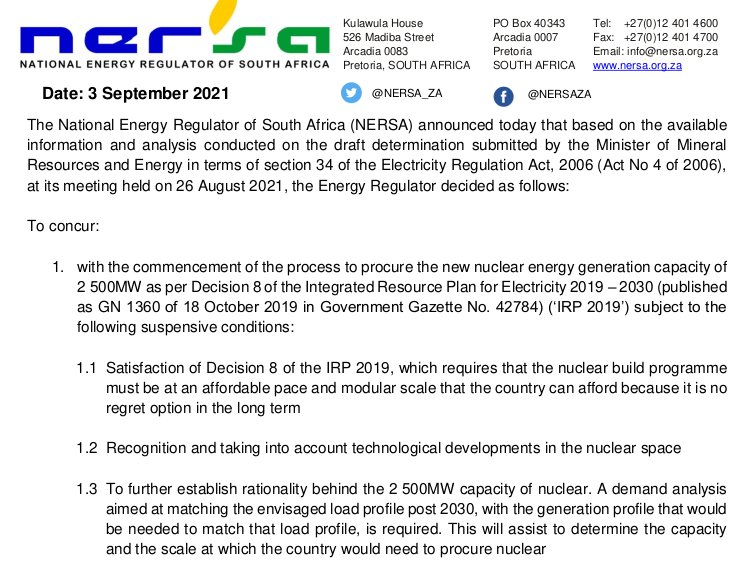
NERSA conditional concurrence with new nuclear

The National Energy Regulator of South Africa (NERSA) has given a conditional concurrence with the section 34 ministerial determination to proceed with procuring a new nuclear plant. This concurrence has some crucial suspensive conditions, in particular 1.3. This makes it clear that given the information put before NERSA, the decision to go ahead with a nuclear build cannot be considered rational.

Continue reading

Civil society responds to reports of Koeberg contract

It was recently widely reported in the media that a US-based engineering company has been awarded a portion of a R20bn contract to extend the life of the Koeberg nuclear power plant. Activists and civil organisations are concerned that the legal processes required to grant a licence for a life extension have not been followed.

Koeberg’s nuclear licence expires in 2024

In order to operate beyond 2024, Eskom needs the approval of the NNR, and a new licence to be issued. This licencing process is described in new regulations published in March 2021, which requires a notice in the government gazette as well as announcements in local newspapers. This would allow the public to make comments for the NNR to take into account before making a decision. However, it appears that this process has not been followed.

Continue reading

Contract to extend the life of Koeberg nuclear plant already signed?

The KAA has noted recent media reports that claim Jacobs Engineering Group has secured a contract to extend the life of the Koeberg nuclear power plant.

Koeberg is operated by Eskom, under a licence from the National Nuclear Regulator (NNR) which expires in July 2024. In order to operate beyond that date, Eskom needs the approval of the NNR for the life extension, and a new licence to be granted. This licencing process requires a public participation process which the NNR is obliged to take into account before making a decision.

The fact that this contract has been announced before the NNR has indicated it has even received the life extension application from Eskom is deeply concerning. The NNR has the mandate to protect the public, but to allow Eskom to ignore due process and make this announcement as if the extension is a ‘done deal’ calls into question the independence of the NNR.

Continue reading

Thyspunt nuclear hearings distract from Koeberg problems

The National Nuclear Regulator (NNR) has announced public hearings relating to an Eskom application to licence the Thyspunt site in the Eastern Cape for a new nuclear plant build. The hearings will take place on 25 and 26 August 2021 in St Francis Bay and Jeffreys Bay respectively. 

Brief EIA history

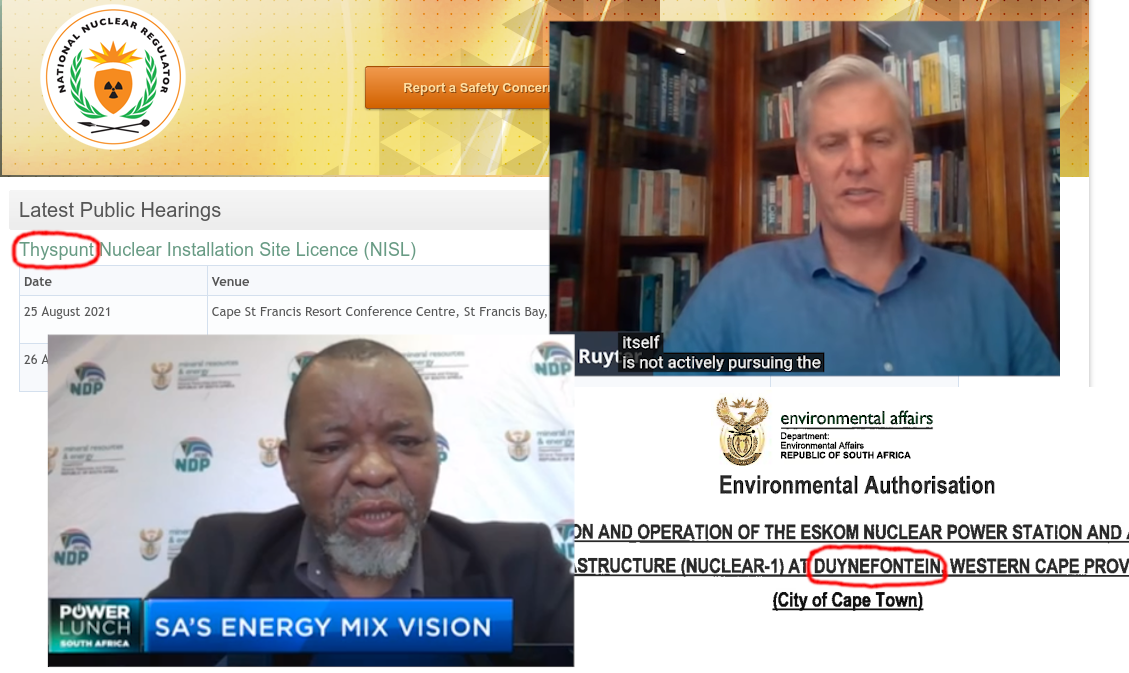
Composite showing documents supporting both Thyspunt and Koeberg sites

Thyspunt lies 80k west of Gqeberha (formally known as Port Elizabeth), in between St. Francis Bay and Oyster Bay. The site was one of three proposed by Eskom for a new nuclear installation in 2008, the others being Duynefontein (next to Koeberg outside Cape Town) and Bantamsklip (near Hermanus in the southern Cape). The Environmental Impact Assessment (EIA) found that the Thyspunt site was the least risky however in a surprise move the minister for the environment approved the project in 2017, but named Duynefontein for the build. This decision was appealed, and four years later, no decision on that appeal has been made.

Continue reading

Nuclear Regulator finally appoints a civil society representative

At a Cabinet Meeting held on 21 April 2021, the addition of a civil society representative to the board of the National Nuclear Regulator (NNR) was finally announced.

The NNR board has been without a civil society representative since August 2020 flouting compliance with the NNR Act. According to several organisations, this lack of representation has contributed to weakened governance at the NNR whose role is to ensure nuclear safety in South Africa, particularly at Koeberg Nuclear Power Plant (Koeberg).

Appointment is welcomed but overdue
The new board member, Koeberg Alert Alliance’s (KAA) spokesperson, Peter Becker, says, “The NNR board has been without a civil society representative for nearly nine months and while this announcement is welcome, it is long overdue. Civil society is an essential part of oversight for government and this is a step towards ensuring the NNR applies the highest international safety standards to nuclear installations in South Africa, and the Koeberg plant in particular.

Continue reading

Koeberg Emergency Plan conflicts with COVID-19 regulations

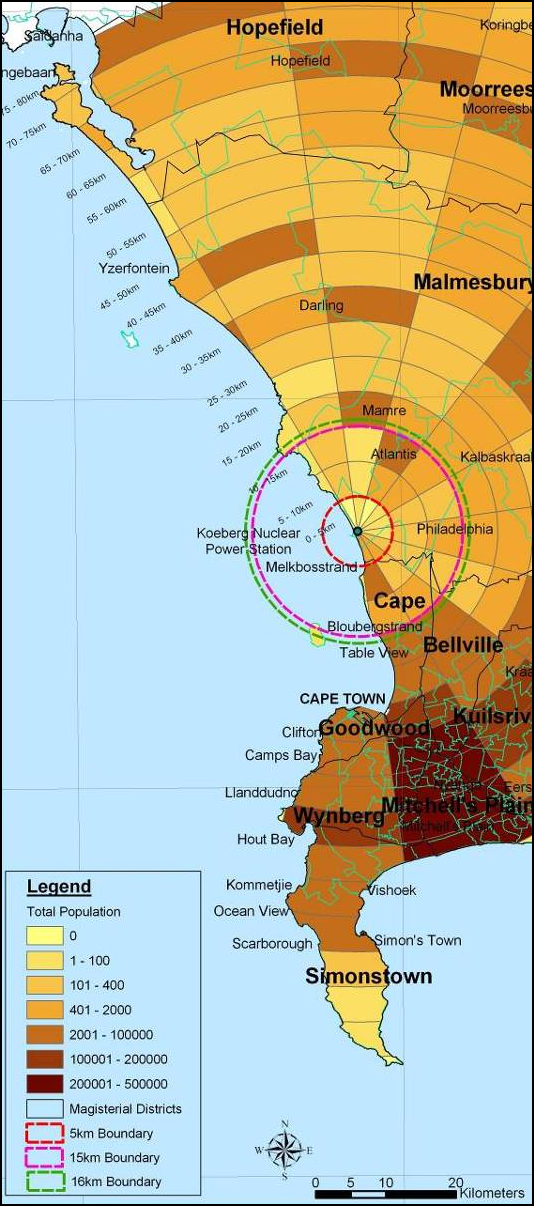
Koeberg Population Density Map

Nuclear-1 EIA App E18

A nuclear incident requiring an evacuation around Koeberg would have a significant effect on the spread of COVID-19. During an evacuation, social distancing will not be followed as people pack into any available transport. Travel restrictions will either be suspended by the government, or overridden by the public possibly with bloodshed. No roadblock can stop 80 000 panicking people! Continue reading

Extension Granted for Appeal Against Nuclear-1 Authorisation

On 11 October 2017 the Department of Environmental Affairs (DEA) issued an authorisation to Eskom for a second nuclear power plant at Koeberg, 28km north of Cape Town City centre.  This was in response to a final Environmental Impact Report submitted to the Department by Gibb (Pty) Ltd on behalf of Eskom, the applicant.

Please sir, may we have some more time?
We wrote to the Department on 30 October, requesting an extension of the 30 day appeal period, which was set to expire on 1 December 2017. Continue reading

Official report on Fukushima – what can South Africa learn?

An independent in depth report on the Fukushima nuclear disaster commissioned by the Japanese parliament was released in July 2012,  and it comes to some very important conclusions.  As Eskom attempts to get approval to build three more nuclear plants along the southern coast, South Africa should be looking very closely at this report to see if there are lessons we should learn from it.

The earthquake or the tsunami?

The tsunami swamping the sea barrier at Fukushima

The nuclear industry has repeatedly made the claim Continue reading