During a recent trip to Fukushima, there was the opportunity to see first hand the effects of the nuclear disaster on the surrounding areas, and to speak to people living there whose daily lives have been affected, and will continue to be affected. With the one anniversary approaching, its an appropriate time to look back over the year and consider what actually happened. Continue reading
Author Archives: Koeberg Alert
Measuring radiation in Fukushima, Japan
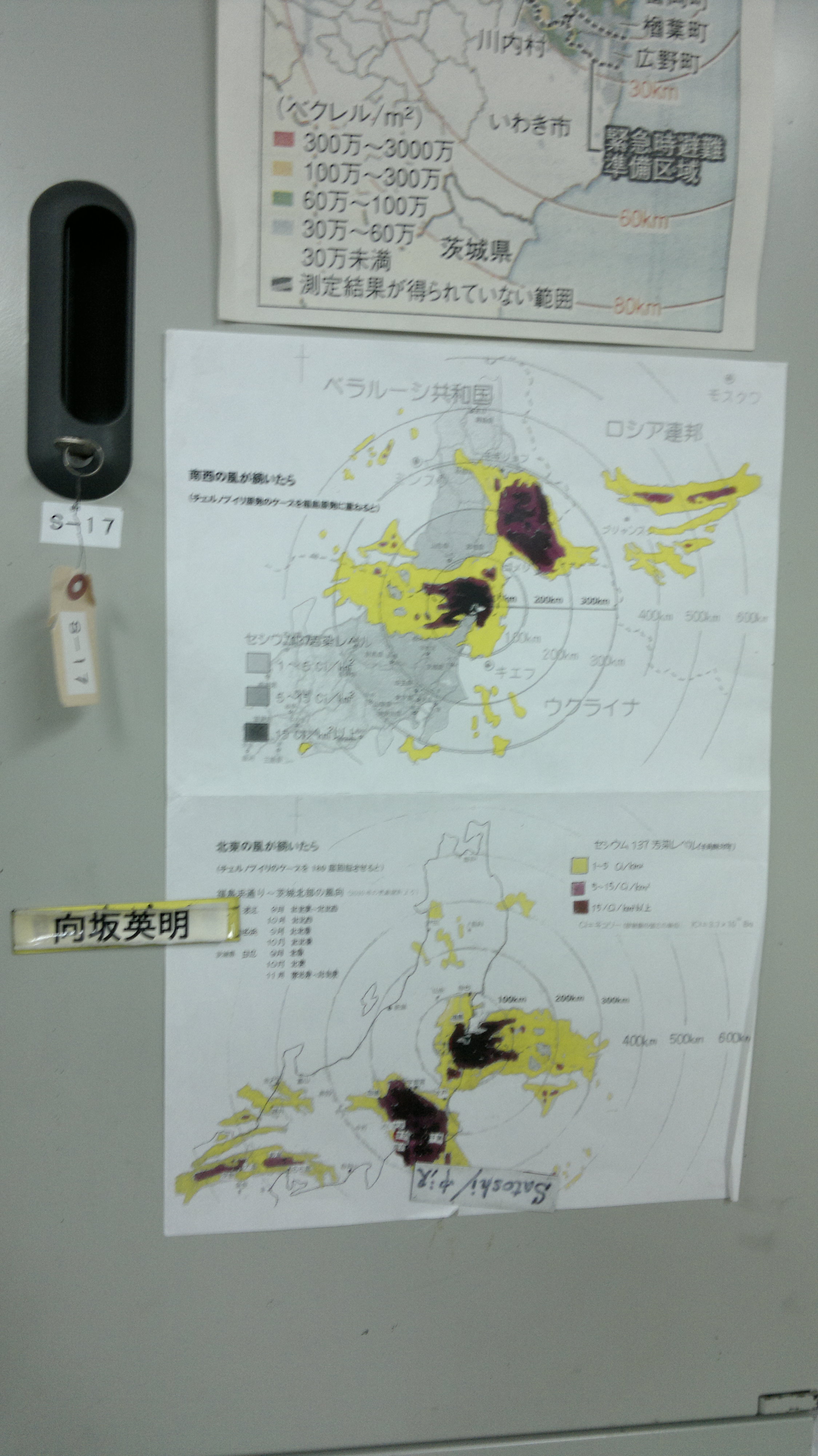
Radiation contamination map
During our recent trip to Fukushima, we carried two geiger counters with us, one inside the bus, and one taped to the outside of the window, facing inwards.
These geiger counters measure gamma radiation, and give a readout in micro Sieverts per hour, or μSv/h. Most people in the world are not familiar with these units, but, of course, here in Japan there is a high level of familiarity and interest in radiation levels. For example, on the right is a map stuck on the lockers in an office I went to. Continue reading
On the ground in Fukushima
I am sitting in a hotel in Tokyo, after attending the Global Conference for a Nuclear Power Free World this past weekend. The sessions were video recorded, and was streamed in real time. Over 100 000 people watched the streaming. See http://npfree.jp/english/
Before the conference we were taken on a two day tour of Fukushima city and some areas nearby, and listened to local people talk about the experience, Continue reading
Nuclear industry in trouble
The nuclear era can be divided into BF and AF – before and after Fukushima. The disaster in Japan was a watershed moment, even prompting the normally up beat International Atomic Energy Association (IAEA) to issue a statement in September 2011 downgrading their predictions for the growth in the nuclear industry. The CEO of one of Germany’s power companies said the industry would face ‘extraordinary costs’ due to the resulting market shifts.
Areva’s future uncertain
Presentation on nuclear power at Hermanus town hall
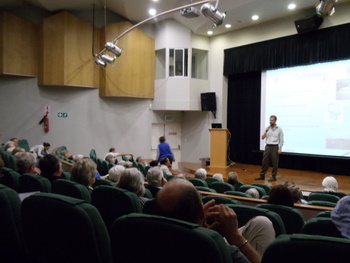
Hermanus talkHermanus talk November 2011
In November 2011, the Save Bantamsklip campaign arranged a public meeting at the Hermanus Town Hall. There was a good turnout, which included the Executive Mayor of the Overstrand municipality, Nicolette Botha-Guthrie. Continue reading
Why Eskom’s electricity demand forecasts are wrong – again
Eskom gave input into the Departments of Energy IRP2010 (Integrated Resource Plan) – some would say they wrote it on behalf of the Department. One of the key factors in planning electricity generation capacity is knowing what the demand will be. Currently, the electricity demand peaks at just under 40 000MW. Eskom projected than by 2030, the demand would be about 85 000MW, or about 4% compounded demand growth, every year. Continue reading
Statistically, how safe is nuclear power?
 ‘Safe’ is an interesting word, in that it means different things to different people. To the public, ‘safe’ often means ‘cannot fail’, whereas to an engineer, it only means that something is within the accepted safety standards. Continue reading
Evacuations and after effects of the Fukushima nuclear disaster
It is not unusual for those who favour nuclear power to downplay the effects of nuclear disasters that have happened. In the article “Nuclear power is a key part of SA’s future”, attributed to the South African Minister of Energy Dipuo Peters, I came across this example: ‘The International Atomic Energy Agency (IAEA) mission to Fukushima at the end of May 2011 concluded that “to date no confirmed long-term health effects to any person have been reported as a result of radiation exposure from the nuclear accident”‘. Continue reading
Top COP or Flop COP?
And finally, its over. Negotiations carried on until 3.30am this morning, and ended with the ‘Durban Deal’. It has three main features.
The Three Part Deal – KP, GCF, and … something
Firstly, the Kyoto Protocol (KP) will be extended in its current form for five years. Civil society is divided on whether this is a flop or ‘top’. Continue reading
Final hours of COP17
The final hours of COP17 are drawing to a close. Everyone is tired after two weeks of this process, and many negotiators have already left. The optimistic feelings of yesterday seem to have evaporated. Continue reading
 KOEBERG ALERT ALLIANCE