I am sitting in a conference in Stockholm about nuclear waste. There are speakers from organisations from all over the world including the International Atomic Energy Agency, the Japan Atomic Energy Agency, delegates from many non-governmental organisation, engineers, and academics studying subjects such as nuclear physics, ethics, and geology.

Gene Rowe of the US Nuclear Waste Technical Review Board gave a highly technical presentation about the prospects of dealing with nuclear spent fuel in the USA via a combination of reprocessing and disposal. I got chatting to him afterwards, and asked him about a claim I have heard repeated many times in South Africa.
Category Archives: International
Nuclear waste disposal sites likely to be close to nuclear power stations
I am in Upsala, Sweden, as a guest of the Swedish Society for Nature Conservation (SSNC). It has nearly 200 000 paying members, a full-time staff of about 90, and produces a magazine every two months for its members. It has been an interesting first day in Stockholm, with a lot to take in.
Sweden generates about half of its electricity from nuclear power, and, like all countries with nuclear power, the country is wrestling with the issue of what to do with the spent nuclear fuel, or in technical terms, the high level waste. This remains dangerously radioactive for thousands of years, and disposing of it safely is a huge engineering challenge. Continue reading
Official report on Fukushima – what can South Africa learn?
 An independent in depth report on the Fukushima nuclear disaster commissioned by the Japanese parliament was released in July 2012, and it comes to some very important conclusions. As Eskom attempts to get approval to build three more nuclear plants along the southern coast, South Africa should be looking very closely at this report to see if there are lessons we should learn from it.
The earthquake or the tsunami?

The tsunami swamping the sea barrier at Fukushima
The nuclear industry has repeatedly made the claim Continue reading
Nuclear ‘renaissance’ stillborn
First published in Business Day, 23 July 2012
The nuclear power industry is deeply troubled, with little cause for optimism. There is growing worldwide public resistance to nuclear power stations, President Obama has terminated government subsidies in the USA for nuclear power, and Germany and Switzerland have committed to shutting down all their reactors. While the renewable energy industry has seen dramatic growth and constantly falling costs, the nuclear industry grapples with spiralling costs, the seemingly intractable waste disposal issue, and the ongoing huge economic and human costs of the Fukushima nuclear disaster.
A renaissance?
Cleaning up Japan after the Fukushima Nuclear disaster
I have written before about what happened in Fukushima in March 2011, and about measuring radiation levels in Japan. Given the situation there, a major question is: how can the contamination been cleaned up?
Removing the top 5cm
Most of the longer lasting radioactive material released was caesium-137, which is a metal that boils at a low temperature (641° C). Large quantities of caesium vapour were released into the atmosphere, and this condensed into very fine particles, which were spread by wind and rain and deposited on over a thousand of square kilometers. Each atom of caesium-137 is unstable, and within about 30 years, half of them will decay, releasing gamma rays. Caesium can form salts (similar to sodium chloride, or table salt) which are absorbed into plants and by animals and humans. Continue reading
Measuring radiation in Fukushima, Japan
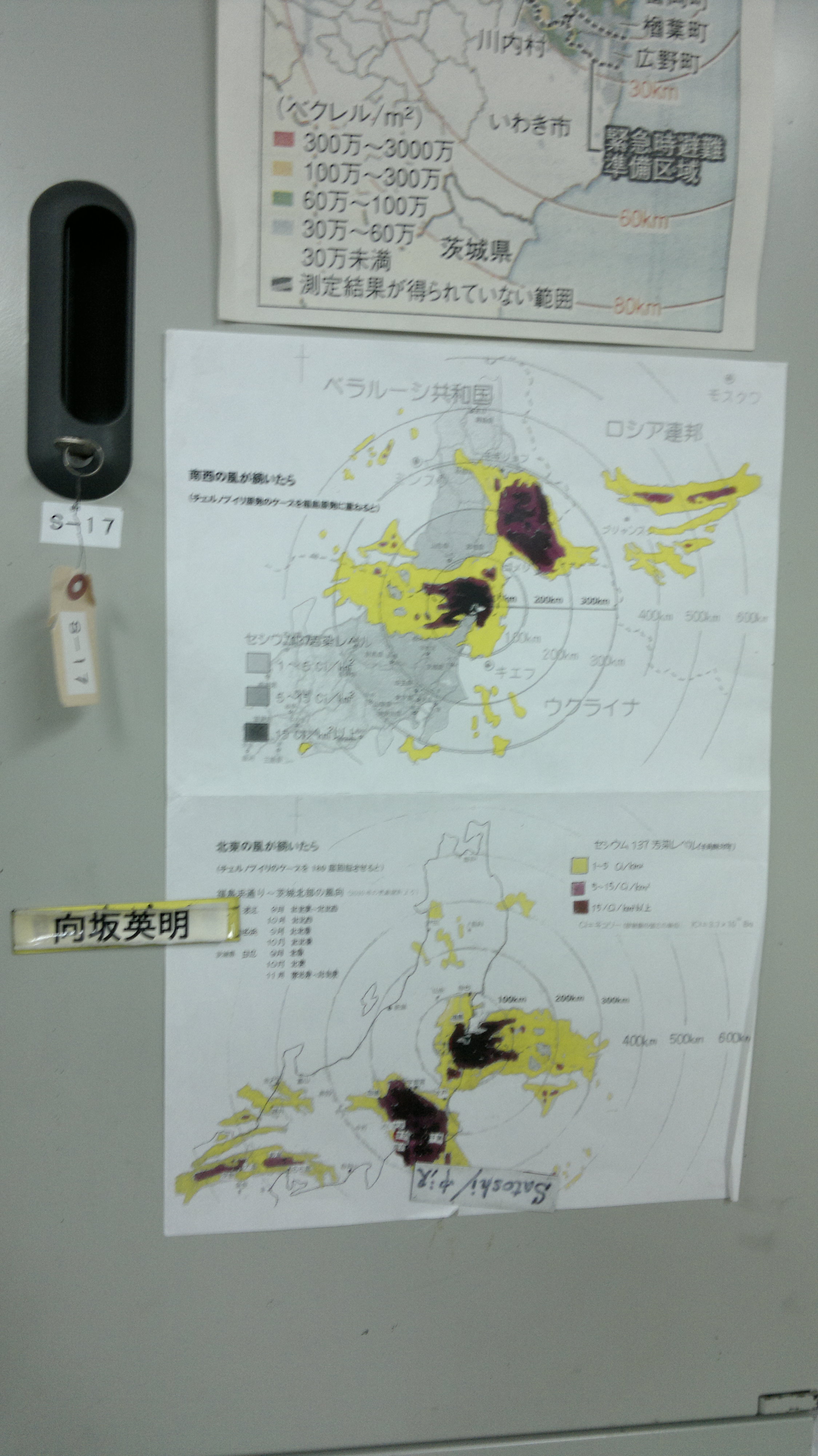
Radiation contamination map
During our recent trip to Fukushima, we carried two geiger counters with us, one inside the bus, and one taped to the outside of the window, facing inwards.
These geiger counters measure gamma radiation, and give a readout in micro Sieverts per hour, or μSv/h. Most people in the world are not familiar with these units, but, of course, here in Japan there is a high level of familiarity and interest in radiation levels. For example, on the right is a map stuck on the lockers in an office I went to. Continue reading
 KOEBERG ALERT ALLIANCE