As described in a previous post both Minister Mantashe and the National Nuclear Regulator (NNR) appealed against Peter Becker’s victory in the Western Cape High Court in January 2023. Despite the High Court refusing leave to appeal, the appeal was heard by a full bench of five judges at the Supreme Court of Appeal in Bloemfontein on 17 May 2024.
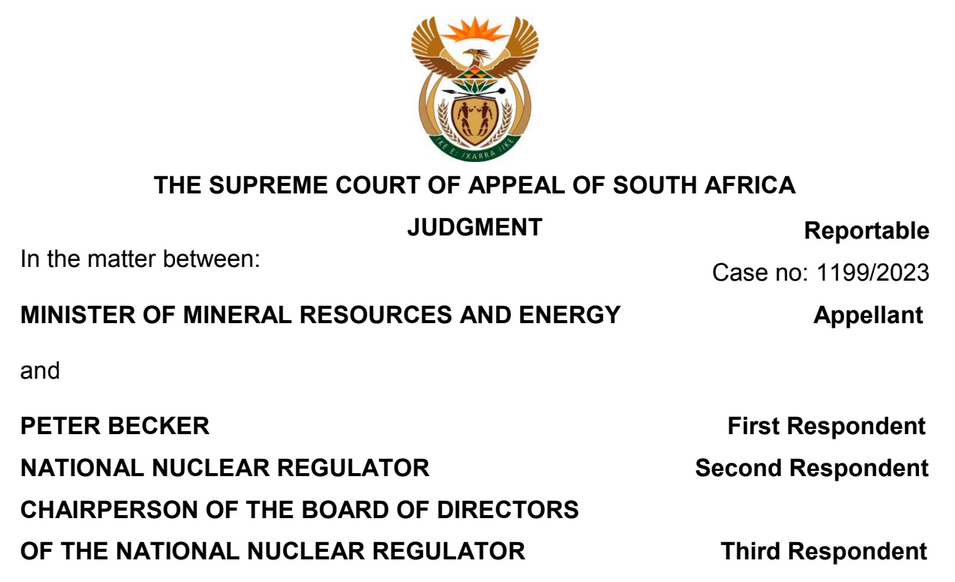
The Supreme Court of Appeal issued a ruling on 28 June 2024 upholding the High Court findings, as well as making additional observations. The NNR and the Minister could have appealed again to the Constitutional Court, but the deadline to do so passed on 19 July without either party filing papers to the Constitutional Court.
The original case was filed in response to Minister Mantashe dismissing Becker from the Board of the NNR, where he was appointed to represent the interests of communities. Becker asked to High Court to review the Minister’s decision, and the High Court ruled that Mantashe’s decision to dismiss was unlawful, unconstitutional and done in bad faith with an ulterior motive with undue haste.
The following describes the appeal hearing, the ruling and also includes the full Heads of Argument submitted to the Court and the full Ruling (see bottom of this article).
Was the dismissal justified?
The judges on the bench were Molemela P, Schippers JA, Meyer JA, Tlaletsi AJA and Koen AJA with Judge Molemela presiding. The parties agreed in chambers that the advocates for the Minister and the NNR (advocates David Borgstrom and Ismail Jamie) would present their case for the first hour and a half, followed by an hour for the advocates for Becker (advocates Geoff Budlender and Mitchell de Beer), and then finally the advocates for the Minister and the NNR would have time to respond.
The hour and a half session turned out to be three hours, with the judges frequently interrupting to ask questions. It was clear that the judges had studied the voluminous court record carefully. Ten minutes into Borgstrom’s time, while he was trying to describe why Becker’s meeting with civil society on 22 July 2021 was “misconduct” worthy of immediate dismissal, a judge interrupted with questions. He asked if Becker was “expected to sever ties with civil society” once he had been appointed as their representative, why it was wrong for civil society to communicate concerns to Becker, and why they should “be forced to send their concerns” directly to the NNR as the NNR had claimed in its affidavit. After Borgstrom’s attempt to explain that, the same judge asked “Isn’t this a bit nit-picky?” This type of interaction continued, with the judges appearing baffled why Becker, as the civil society representative on the Board, should have been forbidden to meet with civil society, and why that was even a conflict of interest, let alone misconduct.
Borgstrom was also asked why Becker’s well known anti-nuclear stance was misconduct, while others on the Board had openly expressed a pro-nuclear view and had not been dismissed. The Board was on record in minutes from July 2021 that they were concerned about “the impression that the Board was pursuing a pro-nuclear power stance.” and in his Answering Affidavit to the High Court the Board chair stated that Becker’s views were in conflict with “the independent stance on nuclear activity which the NNR upholds.” In contrast to this statement by the Chair, he Supreme Court ruling found that “The Board itself and its chair have also adopted a pro-nuclear stance, which was also included in their annual report presented to Parliament in 2022.” Such a pro-nuclear stance casts doubt on the ability of the NNR to fulfil its function as an independent regulator. This was a concern as far back as 2013 when the International Atomic Energy Agency found evidence that resulted in them “calling into question the effective independence of the NNR.” The root of this problem is that the NNR falls under the authority of a Minister who is promoting the use of nuclear power, which is exactly what the Japanese government identified as leading to the regulatory failure that was the root cause of the Fukushima nuclear disaster.
The judges then moved on to the eight reasons given in Becker’s Heads of Argument (see link at bottom of this article) as to why the dismissal was unlawful, with a focus on the issue of the life extension of the Koeberg Nuclear Power plant.
Thought crime?
The Minister and the NNR had claimed that a reason for Becker’s dismissal was his anti-nuclear views which meant that he would have voted against the life extension of Koeberg when that came before the Board. A judge asked if the Minister has a “crystal ball” and knew how Becker would behave in the future, and labelling this as misconduct would be equivalent to a “thought crime”.
A judge also read out the quote from Mantashe which said “If you resist nuclear and you [are] a board member, I fire you, simple. You can’t be in a board of something you’re not advocating for.” and queried why this was not given as one of the official reasons for Becker’s dismissal. This statement from the Minister was yet more evidence that the NNR was not functioning as an independent regulator.
It did not go much better for Borgstrom when the issue arose of Becker’s email to the NNR Chair expressing concerns about the risk of the NNR coming under pressure to grant a life extension by incremental decision making about the work being done at Koeberg. The Minister and the NNR had attempted to categorise this as misconduct worthy of dismissal. A judge asked “What is wrong with him expressing his concerns to the Board?” and went on to say that “From my view the purpose is to have a variety of views” present on the Board and anyway that “communication between Board members is confidential” and Becker’s email to the Chair “cannot be held against him” and hence was not in any way misconduct.
It is of interest that subsequent to Becker writing this email, the NNR submitted a report to parliament, which included a risks register which described a very similar concern: “Undue pressure to finalise informed regulatory decision for LTO”. (The life extension is also referred as the Long Term Operation, or LTO.) This risk was rated at an unacceptable level, hence highlighted in red, and no adequate mitigation steps were listed.
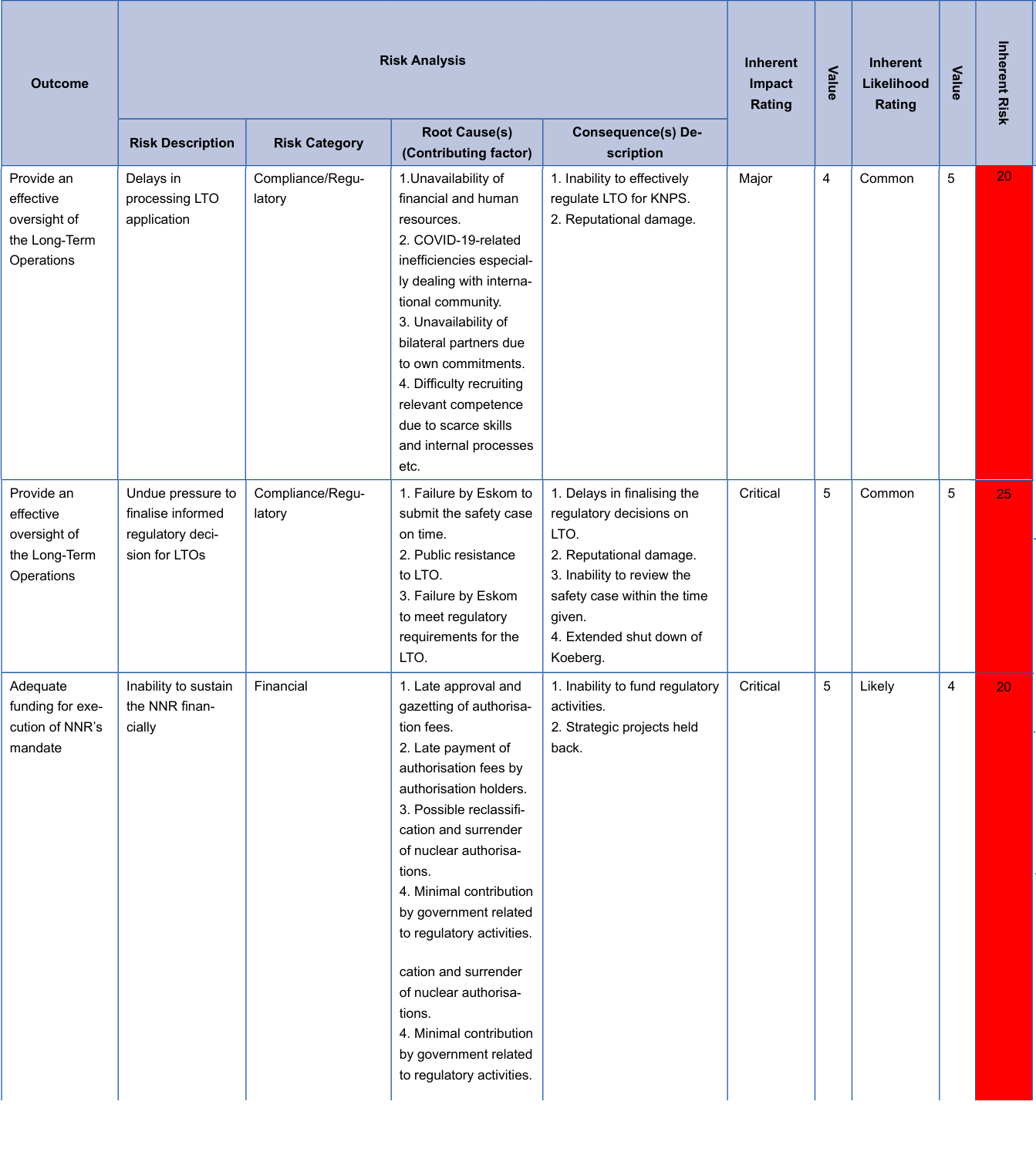
The actual decision on the LTO was eventually announced by the NNR on 15 July, less than a week before the licence to operate Koeberg expired, despite the “Failure of Eskom to submit the safety case on time”. The NNR have, as at 22 July, not yet released the full updated licence with the conditions it contains.
Koeberg Life Extension – a touchy subject
The Minister’s Heads of Argument alleged that “Becker repeatedly sought – despite correction – to improperly mire the deliberations of the NNR board” about the life extension of Koeberg in considerations about financial viability.
The judge asked if any of these repeated attempts by Becker were recorded in meeting minutes, and Borgstrom replied they did, in the minutes of the Board meeting of 29 October 2021. When asked “Where?” Borgstrom backtracked and replied that he “cannot point to an occasion or any specific minutes” where this occurred.
Becker had been quoted in a Daily Maverick article as saying that “Koeberg will never be as safe as a modern nuclear plant”. Borgstrom repeatedly misquoted this to the court, claiming Becker has said “Koeberg will never be safe” and had therefore prejudged the matter which would come before the NNR Board in time. When called out about this by Budlender later in the hearing, Borgstrom stood up and apologised to the court for misquoting Becker.
Some things were not aired in the hearing…
The time allocated to Becker’s advocates was very limited, and there were many allegations to refute. That meant there was no time to raise some other issues which were clear from the papers before the Court.
One of these is that before Becker was suspended from the Board by the Minister on 18 January 2022, under instruction from the Board chair, Becker was excluded from receiving emails sent to the Board, including the Board pack and invitation to a meeting on 18 January. This was unlawful, as the chair does not have the authority to exclude a Board member from a Board meeting. Possibly coincidentally, It was during this time that the Board deliberated whether or not to allow the steam generator replacement process to begin at Koeberg. That permission was given also on 18 January – a decision which ended up costing Eskom R950m in a claim from Framatome, who arrived in South Africa but then refused to begin the work due to lack of preparation by Eskom. It is an open question why the NNR did not pick up the rather obvious problem that the building required to house the old radioactive steam generators had not yet been built.
Another issue was the contradictions in statements made by the chair of the Board at the time, Dr Thapelo Motshudi, about Becker’s membership of the KAA. Motshudi wrote in his Answering Affidavit to the High Court in paragraph 12.2 “Whilst, on its own, the fact that the applicant was a member of the NNR Board while also acting as the spokesperson for the Koeberg Alert Alliance (“the KAA”), does not disqualify him from serving on the NNR Board and from fulfilling his fiduciary duties, …”. This echoed statements made by Motshudi in previous Board meetings, as recorded in minutes submitted to the court. However, Motshudi appeared to have a very different point of view when writing his Supporting Affidavit to Supreme Court. In paragraph 21 he wrote that “having failed to relinquish his position as a KAA spokesperson upon acceptance of his position as a non-executive director on the NNR Board, Becker committed misconduct as contemplated in section 9(1)(c) of the NNR Act.” In essence, Motshudi claimed that Becker should have been dismissed for following the advice given to him by Motshudi.
Another issue that did not get aired was the perjury committed by Motshudi in his answering affidavit to the High Court where he stated in paragraph 79.4 “The Minister was provided with a copy of the MacRobert opinion on 11 October 2021, after this was approved by the Board at a meeting convened on 8 October 2021.” This was a fabrication, as no such approval was given by the Board, which had not even been presented with a copy of the MacRobert opinion by 11 October. The Board was also not provided with a copy of the letter written by Motshudi on 11 October, assisted by the deputy chair who is a lawyer, Dineo Peta, in which they asked the Minister to dismiss Becker by writing we “request the Minister to act on it since the Minister is the competent authority that is responsible for appointment and removal of NNR board members.” The legal opinion was in fact only presented to the Board at a meeting on 29 October 2021, as is plain from the minutes of that meeting which are included in the court papers. At that meeting, the other Board members could not understand the point of discussing the legal opinion, since Motshudi and Peta had already placed the matter in the hands of the Minister with a request that he act on it. The Board had been effectively bypassed.
Becker’s appeal re extension of term
When approaching the High Court, Becker requested that the court order that his term be extended by the period he had been unlawfully excluded from Board meetings, which at that stage was about six months. Unfortunately, due to a misunderstanding, this was not mentioned in the High Court ruling written by Judge Mantame. Mantame later apologised for this, but was not able to change her ruling due to the legal principle of res judicata. Becker asked the Supreme Court to rule that an appropriate remedy for the unlawful dismissal was an extension of the date of the end of his term on the Board so that he could serve an effective three years.
The first argument against this was that the High Court had failed to make an order on the issue, and an appeal can only be made against an order. A judge expressed his opinion that the only option seemed to be to strike the appeal from the roll. Another judge referred the NNR Act of 1999 which gives communities the right to nominate a representative every three years, and that extending Becker’s term would deprive communities of that right, pointing out that there was no evidence before the court that communities still wished to be represented by Becker. Such evidence was unnecessary when Becker first applied to the High Court, and the appeal process does not allow new evidence to be submitted.
Another factor was that the three year term started on 10 June 2021 and therefore ended on 9 June 2024. As expected, a ruling was not issued before that date, and so Becker’s term formally ended a few weeks after the hearing. Extending Becker’s term would already have been a novel remedy, and the Court reappointing him after his term had expired could have been seen as judicial overreach. Despite losing the case, by pursuing repeated appeals the NNR and the Minister effectively achieved their initial aim of excluding Becker from the Board for the rest of his term.
What’s next?
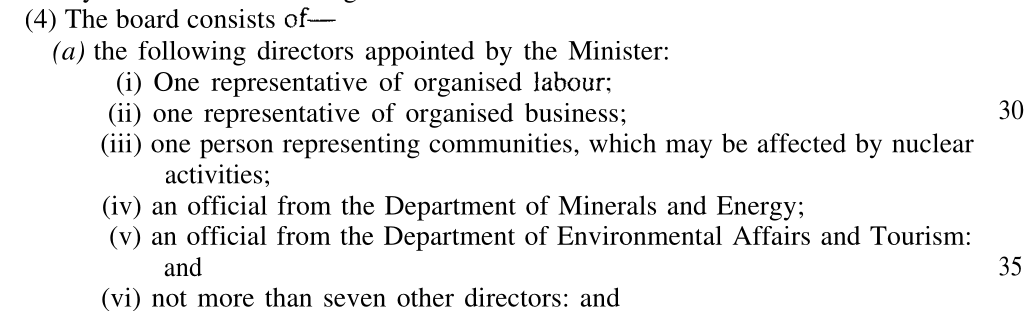
The post of a Board member representing the interests of communities on the NNR Board, as required by the NNR Act, has been vacant for two and a half years, and seemingly neither the Minister nor the NNR are in a hurry to have anyone appointed. The CEO of the NNR even addressed the parliamentary oversight committee on 8 December 2023 and requested that the role be removed from the NNR Act via an amendment.
Since the split of the Department of Mineral Resources and Energy into the Department of Electricity and Energy and Department of Mineral Resources and Petroleum, there has not been clarity from the President as to which Ministerial office the NNR now falls under. Whoever is in that post should have already been in the process of appointing a community representative to the Board.
Despite the Supreme Court of Appeal ruling, it is clear that the losers have been the communities potentially affected by nuclear installations, whose interests have been unrepresented at Board level over a time when the NNR has made the most important decision in its existence, i.e. whether or not Eskom will be permitted to operate Koeberg, uncomfortably close to the City of Cape Town, for another twenty years.
An appeal can now be made within sixty days to the Minister, whoever that is, to overturn this decision by the NNR Board. There is however, no prescribed time within which the Minister is obliged to make a decision on such an appeal. Should an appeal fail, the decision of the NNR Board can be taken on review to the High Court.
The of the Heads of Argument of the Minister
https://drive.google.com/file/d/19m47tR6atJkAi7MYhj-we7nu-N5vs6ez/view?usp=drive_link
The of the Heads of Argument of the NNR
https://drive.google.com/file/d/1l5UH_l8r7r2PwC0N0LuwtdhYeNGzuNVF/view?usp=drive_link
The of the Heads of Argument of Becker
https://drive.google.com/file/d/1rdAdKkNRBcZoWutvISj6p3N3fJf7PiOh/view?usp=drive_link
The affidavit submitted by the Chair to the High Court
https://drive.google.com/file/d/1SsE8hx2YicNXlHIbo015VfFrMBzXrRX5/view?usp=drive_link
The Supreme Court of Appeal ruling of 28 June 2024
https://drive.google.com/file/d/1bPm7mFlqDg8c8BgiIbgwd-QOWS47c9Y_/view?usp=drive_link
 KOEBERG ALERT ALLIANCE