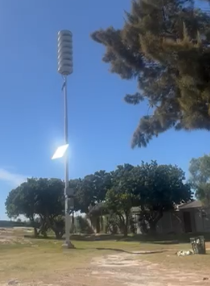
Koeberg Nuclear Power Station conducted full-volume siren and speaker tests of the Koeberg Public Warning System on 3 March 2026. The sirens form part of The Koeberg Emergency Plan and are intended to ensure that the public warning system is fully functional and able to alert communities within the 16-kilometre emergency planning zone — including Atlantis, Duynefontein, Melkbosstrand, Philadelphia, Bloubergstrand and Parklands — in the event of a nuclear incident.
The alert system includes both a siren tone and a spoken public address message. Mixed reactions were reported from residents in the surrounding communities, with many saying the audio announcements were difficult to understand or could not be heard clearly inside their homes.
Siren system from the 1980’s
Koeberg’s nuclear emergency warning system still relies largely on siren towers and loudspeakers, a technology designed decades ago when people were expected to hear alarms outdoors. In practice, this system has significant limitations. People may be indoors, in meetings, or listening to music or podcasts on earbuds, and even when the siren is audible, residents may struggle to understand the spoken announcements, particularly inside buildings or in windy conditions. There is also no way to confirm whether the warning was actually received or understood.
Project 90 by 2030’s Energy and Outreach Officer, Lydia Petersen, was in the emergency planning zone on the day of the test. “The siren and accompanying message were clearly audible in areas closer to Koeberg,” she said. “However, further away in Melkbosstrand, the siren could be heard but the spoken message was not audible.
“A more serious concern emerged in Wolwerivier, a community located 14 kilometres from Koeberg and therefore well within the official 16-kilometre emergency planning zone,” Petersen added. “No siren and no message were heard at all during the testing window. This means that a community inside the designated emergency zone received no warning signal.”
Petersen also noted that the announcement was broadcast only in English. “The surrounding communities are multilingual, which raises concerns about whether all residents would understand instructions in a real emergency.”
“SAFCEI is deeply concerned with the lack of language diversity observed during the recent ESKOM siren test,” said The Southern African Faith Communities’ Environment Institute’s (SAFCEI) Senior Energy and Climate Justice Coordinator, Ntombizodidi Mapapu. “This is an urgent issue that must be addressed, as the exclusion of non-English speakers within the radius poses a significant risk. If an accident were to occur at Koeberg, a large number of people would be left uninformed and vulnerable due to this lack of linguistic inclusivity.”
Many countries now use cellular and smartphone-based emergency alert systems that send clear, location-specific warnings directly to mobile phones, reaching people indoors and visitors in the area. Given the National Nuclear Regulator’s (NNR) responsibility to ensure public safety, the continued reliance on an outdated siren system raises questions about why Eskom has not been required to implement a modern, phone-based public warning system for communities around Koeberg.
Such systems could also deliver alerts in multiple languages, helping to ensure that emergency instructions are understood by the diverse, multilingual communities living within the emergency planning zone.
International best practice
International best practice for nuclear emergency preparedness is guided by standards from the International Atomic Energy Agency (IAEA). These require countries to have comprehensive emergency plans that include hazard assessments, clear response procedures, public communication systems and regular drills.
A key principle is that warning systems must reliably reach the public quickly and clearly. Many countries therefore use multi-channel alert systems, combining traditional outdoor sirens with radio and television alerts, automated phone warnings and cell broadcast messages sent directly to smartphones. Systems such as Wireless Emergency Alerts in the United States and national cell-broadcast alerts used in parts of Europe can deliver location-specific instructions to everyone in an affected area, including people indoors and visitors. Nuclear regulators play a central role in ensuring these systems exist and function properly.
According to Eskom’s “Emergency Plan Calendar 2026”, people living within the five kilometer radius of Koeberg will be warned of an emergency through public sirens indicating the need for the public in the area to take “urgent protective actions”. The specific instructions will be relayed to you via Good Hope FM, Kfm 94.5, and SABC television channels. If you live in the 16 kilometre radius from the nuclear power plant, the public sirens in the affected area will be sounded, and instructions will be issued on Good Hope FM, Kfm 94.5, and SABC television channels.
In the age of smartphones and instant alerts, dependence on unclear loudspeaker announcements and local radio broadcasts seems increasingly out of step with modern emergency communication.
If needed, is an evacuation even possible?
One aspect of any nuclear emergency plan is the evacuation of residents from potentially affected areas. To assess whether this is feasible, the City of Cape Town uses a Traffic Evacuation Model (TEM), which estimates traffic flows and how long it would take for residents to leave the emergency zone.
A concerned citizen recently submitted a request under the Promotion of Access to Information Act (PAIA) for the results of this model. The City refused the request, stating that releasing the information could cause “possible public panic regarding evacuation,” “generate unwarranted public alarm regarding evacuation capabilities,” and “undermine public confidence in established emergency procedures.”
In its application to the National Nuclear Regulator (NNR) for a life extension of the Koeberg plant, Eskom stated that the City of Cape Town is updating the evacuation time estimates (ETEs) using the latest population and traffic data. According to Eskom, the current estimates remain valid until the updated Traffic Evacuation Model report has been finalised, reviewed and accepted by the NNR. However, it remains unclear what progress has been made on this update, and no timelines have been provided by the regulator.
In the meantime, the emergency plan continues to rely on an evacuation model that all parties acknowledge is outdated, alongside a public warning system that has yet to move beyond decades-old siren technology.
 KOEBERG ALERT ALLIANCE